01
4–7 min · guided game
Signal Club
Can a team coordinate what nobody can see alone?
Choose local guessing rules, test every deal, and discover what the sight lines make possible.
Interactive research
Four guided games, six deeper tools, and Gomulda. Explore the research through play, or try a game from my mathematical beginnings.
Start with Signal Club, or follow your curiosity. Hints are included; advanced workshops are optional.
4–7 min · guided game
Can a team coordinate what nobody can see alone?
Choose local guessing rules, test every deal, and discover what the sight lines make possible.
5–8 min · guided game
Can majority rule allow disagreement without cycles?
Make a voting cycle, repair it, and build a rich collection of allowed rankings.
7–10 min · guided game
Does winning mean you understand the game?
Beat a predictable rival, test your rule on new positions, and discover the structure of Nim.
5–8 min · guided game
What survives when texts copy earlier texts?
Watch words drift out of a population, compare publication rules, and try to bring a lost word back.
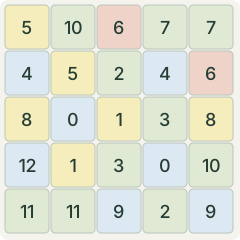
A game invented by Cristoffer Crone
Pair squares into countries, then compete over how economically the resulting map can be coloured. White aims for an expensive map; Black aims to keep the colouring cost down. Swap roles for the second round.
The 5 × 5 board was the one we most often played on in the Danish Gomulda Laug. Start there, against a computer opponent or another person sharing your screen.
These open-ended tools expose more of the calculations. Each now includes a short worked starting point and a guide to interpreting its results.
After Signal Club · graphs and probability
Compare one hidden deal, an exact success formula, and a simulation.
After Signal Club · information theory
Follow fixed points through graph splits and compare the value achieved by different strategies.
After The Assembly · rankings and graphs
Inspect whole preference rankings and the graph of adjacent swaps. Begin with the nine-order example.
After Counterplay · practice and hints
Choose your own heaps, control the opponent’s mistakes, and inspect each move separately.
After Counterplay · impartial games
Edit a board, follow a legal move, and see how the next-position values determine its nimber.
Separate exploration · probability
Compare independent waiting times and find a cycle in pairwise probabilities, with simulation uncertainty.
The four guided games and six specialist tools are small mathematical models. Their research sections explain the assumptions and distinguish classical background, worked examples, and the results in the papers. These ten run locally; paper and video links remain available throughout. Gomulda opens on its separate game website.